When it comes to concrete pumping, there are two main options, and they are line pumps and boom pumps. Both options have their place, but if speed, reach, and efficiency matter, a boom pump is often the smarter choice. At Cempump, we offer both — but more and more of our clients are choosing boom pumps for the added convenience they bring to the site. This article looks at the benefits of both options to help you make an informed choice.
What’s the Difference Between Boom Pumps and Line Pumps?
Line Pumps – When using a line pump, concrete is pumped through a series of ground-level hoses or pipes, manually laid out across the site.
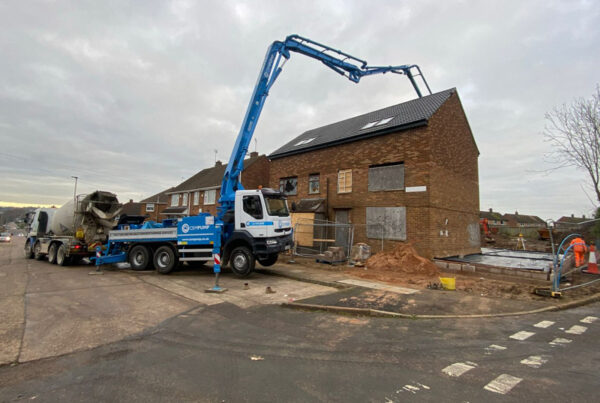
Boom Pumps – When using a boom pump, a remote-controlled hydraulic arm (boom) lifts and places the concrete directly where it’s needed, whether it be overhead, through windows, or over ticky/large obstacles.
Why Use a Boom Pump?
✅ Faster setups – Boom pumps can be up and running in minutes, with no time spent laying or adjusting pipework around site clutter, which reduces the labour, time and cost of the project. Workers can start pouring the concrete when they arrive.
✅ Hard-to-reach areas – Pouring a slab over a fence? First-floor extension? Rear garden with no access? A boom easily reaches over walls, buildings, or tight spaces. Projects with limited access or complex layouts are easier to navigate because the pump can reach more tricky areas than traditional wheel narrows or mixers.
✅ Cleaner sites – Boom pumps mean fewer trip hazards and less disruption to driveways, gardens, or existing structures, as the delivery of concrete is precise and elevated. This also means a reduced risk of spillages, resulting in a safer and tidier site with less waste.
✅ Better flow, less labour – Booms pump more volume, faster, easily carrying out pours of 100m³+. The hose can be positioned over foundations or slabs, making placing concrete easier and less physically demanding, which means less labour is needed. This can speed up the project and reduce the cost. It will also mean less heavy equipment, making the worksite safer and cleaner.
Why Use a Line Pump?
✅ Longer pipe runs – Where boom pumps can’t reach, line pumps can. With pipe runs of hundreds of metres, they might take longer to set up, but are ideal when access is restricted or distance is an issue. This makes line pumps an excellent option for projects that need concrete delivered to trickier areas that are a distance from main roads, as they are versatile and can go through narrow or confined spaces.
✅ Smaller sites and domestic work – Line pumps are smaller trucks that can access tighter spaces, making them less of a nuisance for the surrounding residents. There’s also less waste on completion of the project and a much cleaner site, with minimal product waste.
✅ Cost-effective on smaller jobs – Line pumps are generally more cost-effective as they are cheaper to hire. We charge based on volume and distance pumped, so for small quantities and short distances, they’re often more cost-effective than a boom pump, making them the best option for smaller projects such as pathways, patios, and foundations.
When is a Boom Pump Ideal?
- Here are some great examples of when using a boom pump is your best option:
- Reaching over large obstacles, such as walls, fences, trees, or water
- Multi-storey pours or mezzanine slabs
- Sites with poor ground conditions where using concrete is potentially complex
- Jobs with high volume or where speed is essential
The Cempump Advantage
Whether it’s a boom pump or a line pump, Cempump has all options covered, and we make light work of even the toughest pours. Operated by trained professionals and ready for screed follow-up if needed, it’s the complete concrete solution.
Not sure which pump is right for your project? Give us a call — we’ll guide you to the most efficient and cost-effective setup for your site.
📞 Call: 01332 410021
📧 Email: info@cempump.co.uk
🌐 Web: www.cempump.co.uk
Cempump – taking the hard work out of concreting.