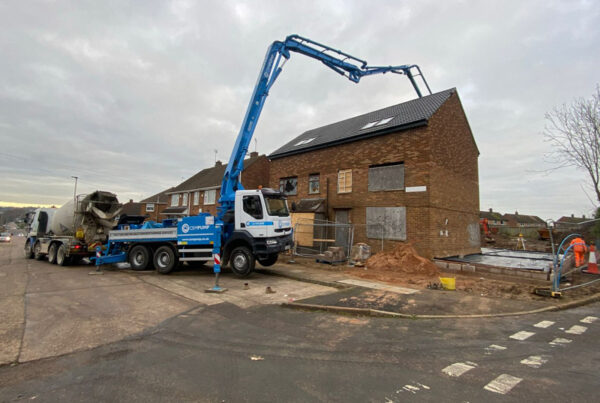
Concrete pumping is the process of moving liquid screed or concrete from a mixing or delivery vehicle to the project site via a system of pipelines. Here, we look at the process of concrete pumping and its advantages.
Concrete Pumping Explained
In contrast to pouring, which involves workers transporting wheelbarrows or similar equipment to and from where the concrete is mixed or stored, equipment primarily carries out this process. Most people choose pumping because it is much more cost-effective and efficient for most projects.
Concrete pumping is usually used for larger-scale projects or when moving concrete from point A to point B is difficult due to obstructions (such as a series of terrace dwellings). To save time, pumps can be utilised for simpler, lesser tasks.
How Does Pumping Concrete Work?
Since the machine handles most of the labour, it is pretty straightforward. A drum mixer delivers ready-mix concrete, or a mix-on-site truck produces the desired concrete design mix. Operators put up the line or boom pump and connect a pump to the truck. Concrete is pumped from the mixer truck to the specified location via a system of pipelines at the touch of a button.
Most concrete designs will flow throughout the room, covering everything and self-levelling, although occasionally, human levelling may be required. Operators will clean up after pumping the necessary quantity and let the concrete cure.
Concrete Pump Types
Boom Pumps
Robotic arms that can lift over obstacles are called boom pumps. They are used to transport concrete or liquid screed into difficult-to-reach areas because of their capacity to extend up and over huge objects, such as houses. To expand their reach and get concrete over obstacles and along the floor to your project area, boom pumps are frequently combined with line pipes.
Line Pumps
Using a line pump is the alternative method of pumping concrete. These pipes sit on the ground and connect. They are employed to navigate through or around obstructions. These are usually utilised for minor work, like driveways or do-it-yourself projects around the house. This approach is incredibly adaptable because you may add as many hoses as necessary to reach the region where concrete needs to be put. Additionally, they are used in areas with height limits, like trees or powerlines, because they don’t stretch up and out.
Advantages of Concrete Pumping
- Enhanced efficiency – concrete is delivered to locations more quickly, saving money and labour time.
- Increased precision – pumps allow for more accurate concrete placement, particularly in confined spaces or intricate sections, and the ability to stop the pouring process at any time to prevent overpouring gives you more control over when to stop.
- Reach challenging locations – By combining line pumps and boom pipes, it is possible to reach places where manual pouring might not be able to.
- Increased safety – Pumping reduces the need for manual labour and handling, which lowers the possibility of accidents and improves site security.
Cempump offers swift and professional concrete pumping. Contact our team to discuss your requirements on 01332 410021.